Showing posts with label Dharmapala. Show all posts

Monday, December 31, 2007

Kalachakra Specific Precepts & Mandala

KALACHAKRA SPECIFIC PRECEPTS:
Six Types of Precepts for Upholding Buddhas

1. Upholding Akshobhya: Generate Bodhicita by committing to attain enlightenment and benefit all sentient beings, act upon the Three Basic Teachings of Buddhism (avoid evils, develop virtues and purify oneself), uphold the vajra scepter, uphold the vajra bell, uphold the mudra of the Buddha's body, and revere the Root Guru.

2. Upholding Ratnasambhawa: Unselfishly contribute one's own wealth and belongings, apply Buddhadharma to guide and help others, overcome their difficulties and protect their safety.

3. Upholding Vairocana: Use five meats and five fluids as wondrous potion to assist one's attainment.

4. Upholding Amoghasiddhi: Make frequent offerings to the Root Guru and the Three Treasures.

5. Upholding Amitabha: Guard the leakage of semen (white bodhicitta).

6. Upholding Vajrasattva: Train in developing the wisdom of non-dualism of emptiness and bliss.


Kalachakra Mandalas

The Kalachakra mandala is a cosmographic representation of the inner, outer, and alternative dimensions of reality. A support for tantric contemplative practice, mandalas are regarded as the actual abode of a particular deity. Presenting the sphere of the deity's presence, the deity's surrounds and the range and depth of a deity's influence, mandalas are meditation devices for actualizing and embodying a specific sublime form.

Encompassing the body, speech and mind of the Kalachakra deity along with the 636 complementary deities in the mandala, the Kalachakra mandala is particularly complex. For this reason, there is an emphasis within the Tibetan Buddhist tantric practice traditions of using supports for contemplation such as replicas of the actual mandala including thangka paintings, 3D constructions, and now computer-generated animations for imagining or visualizing the Kalachakra mandala. What follows are a selection of mandalas of the Kalachakra as a 3-dimensional animation, as photographs of 3-dimensional representations of the mandala, and as traditional thangka painting depictions of the Kalachakra.


Kalachakra Authentic Twenty-Five Prohibited Conducts

A. Five Primary Prohibitive Conducts (Five Basic Precepts):
1. Killing
2. Stealing
3. Engaging in sexual misconduct
4. Not telling the truth
5. Being intoxicated

B. Five Secondary Prohibitive Conducts:
1. Gambling
2. Earning a living through unvirtuous means
3. Reading or distributing evil materials
4. Killing for the purpose of praying to ancestors or spirits (gods, ghosts, etc.)
5. Believing in deviant teachings or paths

C. Five Severe Killing ill-deeds:
1. Killing a man
2. Killing a woman
3. Killing a baby
4. Killing a cow
5. Destroying temples, pagodas or buddha statues

D. Five Harming ill-deeds:
1. Harming a buddha or teacher
2. Harming a sangha member
3. Harming a friend
4. Harming a leader
5. Harming a confidant

E. Five Desirous ill-deeds:
1. Eyes craving beauty
2. Ears craving beautiful sounds
3. Nose craving nice fragrances
4. Mouth craving good taste
5. Body craving pleasures

Kalachakra Authentic Fourteen Primary Root Infractions

1. Disrespectful towards the lineage Root Guru, disturbing the mind of the Root Guru
2. Deviating from guidance or directives from the Root Guru
3. Creating discord, speaking faults of Vajra brothers and sisters, not cooperating with other Vajra members
4. Lack of compassionate heart towards sentient beings
5. Willingly losing white boddhicitta
6. Slandering Mahayana Buddhism and the realization of emptiness through Mahayana practices
7. Revealing Tantra secrets to the unripened practitioners
8. Disregarding the well being of one’s own body, practicing austerity that is harmful to health, despising one`s own five aggregates which are five Buddha embodiments
9. Abandoning, rejecting or opposing Empty Nature
10. Being hypocritical and inconsistent between inner thoughts and outer conduct
11. Doubting or despising Root Guru`s teaching of the wisdom of Supreme Immutable Bliss
12. Using ordinary viewpoint and concept to judge a true yogi/yogini, slandering his/her behavior that does not fit the norm
13. Holding onto one`s own opinion, not committing body and mind to the pledged Tantra precepts
14. Deriding women


Kalachakra Authentic Eight Secondary Root Infractions

1. Engaging in Consort Practice without proper Tantric empowerments (Anyone who is disqualified to receive empowerments or to practice Tantra, anyone who violates the precepts and break his/her vows cannot engage in consort practice)

2. Engaging in Consort Practice without fulfilling the three unities (Inability to merge body, speech and mind with the deity)

3. Transmitting Tantra prior to maturity (Revealing pictures, Tantra texts, mudra or dharma implements of consort practice to the uninitiated or non-believers)

4. Disputing at the time of assembly (Creating dispute at the time of dharma ceremony, group practice, offering rites, etc)

5. Lying to devout practitioners (Misleading or not answering dharma questions asked by fully qualified or devout Tantric practitioners)

6. Staying seven days at the place of a Pratyeka Buddha (Stream-hearer) (Staying more than one week at the home of a Hinayana practitioner that lacks Tantric belief or slanders Tantra)

7. Bearing arrogance prior to realization (Prior to attaining true realization, exaggerating one's own fruition and spiritual power)

8. Transmitting dharma to non-believers (Transmitting secret dharma essences to non-believers)


Note: The above precepts are authentic Tantra infractions for consort practitioners, however, True Buddha School prohibits consort practice altogether. If you violate it or incur any of the above infractions, there are three purification methods:

* In front of the Root Guru (spiritual teacher of heart), sincerely generate heartfelt repentance and then pray for another bestowal of empowerment.

* Practice Homa retreat and sincerely generate heartfelt repentance. Make Homa offering to the Root Guru, all lineage gurus and Buddhas and then pray for another bestowal of empowerment.

* In front of the altar, sincerely generate heartfelt repentance and chant Vajrasattva Hundred Syllable Mantra more than one hundred thousand times and then pray for another bestowal of empowerment.


Hevajra


Hevajra

The first chapter of the awakening of Vajragarbha will help to explain:

Thus have I heard, Lord Buddha was residing in the womb of the Vajra Lady which is the Body, Speech and Mind of all the Buddhas

There Buddha spoke, "The heart of the Body, Speech, and Mind of all the Buddhas is the Noble Lord, who is the most secret of all the secrets. Oh Vajragarbha, great Bodhisattva of great mercy, listen to the essence of Vajrasattva, Mahasattva, and Samayasattva which is known as Hevajra."

Vajragarbha asked Lord Buddha, " Explain to me why He is called Vajrasattva, how is He Mahasattva, by what criteria is He Samayasattva?"

Buddha replied, "Vajra is said to be the indivisible and Sattva the unity of the three Centers. By this kind of wise reasoning Vajrasattva, the Adamantine Being, is so called. He is called Mahasattva because of
being full of the flavors of the Great Knowledge. And He is Samayasattva because of being uninterruptedly active at all times."

Vajragarbha asked, "What is intended by the composite name Hevajra? What is proclaimed by the sound HE and what by VAJRA?"

Buddha replied, "HE symbolizes Great Compassion and VAJRA symbolizes Wisdom. Now listen to this Tantra that I proclaim which is the essence of Wisdom and Skillfull Means.
The proficiency of this Tantra is known to be vast. This Tantra teaches the Gazes, how to attract, the Secret Sign Language, how to paralyze, how to drive away. It teaches the correct method of generating the Yoginis, their location, and their source. It is proficient in the science and technique of the correct method of manifesting the deities.

The first of these techniques is one method, the method of generating the Heruka, for it is by utilizing the existent itself that men are liberated. Oh Vajragarbha of great mercy. Men are bound by the bondage of existence and are liberated by understanding the nature of existence. Oh wise one, existence should be conceived through the understanding of
non-existence and likewise the divine Heruka should also be conceived through the understanding on non-existence.

Great Knowledge is located in the body and is free of all illusory conceptions, pervades all phenomenal things and although abiding in the body does not originate from the body."

Vajragharba asked, " Oh Buddha, how many nerve-channels are there in the Vajra body?"

Buddha replied, " There are thirty-two nerve-channels. These thirty-two are the bearers of the bodhicitta and flow into the center of Great Bliss. Among them three nerve-channels, Lalana, Rasana, and Avadhuti are the most important. Lalana has the nature of Wisdom and Rasana of Skillfull means. In the middle, between them is Avadhuti, free from the duality of subject and object. Lalana is the bearer of Aksobhya and Rasana is the bearer of Rakta. The bearer of both Wisdom and Moon is known as Avadhuti.

The names of the thirty-two nerve-channels are Abhedya, Suksamarupa, Divya, Vama, Vamini, Kurmaja, Bhavaki. Seka, Dosa, Vista, Matari, Savari, Sitada, Usma, Lalana, Avadhuti, Rasana, Pravana, Krisnavarna, Surupini, Samanya, Hetudayika, Viyoga, Premani, Siddha, Pavaki, Sumana, Traivratta, Kamini, Geha, Candika, and Maradarika."

Vajragharba asked, "Lord Buddha, what is the nature of these thirty-two nerve-channels?"

Buddha relied, "The nerve-channels are all transformations of the three realms of existence and are devoid of the duality of subject and object. But when they are used as means, they are all conceived as possessing characteristics of phenomenal things. The various Concealed Essences are mentioned: Ali and Kali, Moon and Sun, Wisdom and Skillfull means,
the centers of Essencial Nature, Enjoyment, Creation and Great Bliss, and the Body, Speech, and Mind. Evam Maya: by E the goddess Locana is indicated, by VAM Mamaki, by MA Pandura and by YA Tarini. In the Center of Creation a sixty-four petal lotus. In the Center of Essential Nature an eight petal lotus, In the Center of Enjoyment a sixteen petal lotus. In the Center of Great Bliss a thirty-two petal lotus.

The fourfold division that follows should be actualized in the proper order of the four centers described above.

The four Moments: Diverse, Ripening, Dissolving, and Signless.
The four Noble Truths: Sorrow, its Origin, its Cessation, and the WAY.
The four Principles: Self, Mantra, Divinity, and Knowledge.
The four Joys: Ordinary, Refined, Cessation, and Innate Joy.
The four Doctrinal Schools: Sthavari, Sarastivada, Samvidt, and Mahasanghi.

Moon, Sun, Ali and Kali, the sixteen Phases, the sixty-four Periods,
the thirty-two Nerve-channels, and the four Watches. Thus, everything
goes in fours.

Chandali blazes up in the navel. She burns the Five Buddhas. She burns Locana and the others. Aham is burnt and the Moon flows down."

Thus the first chapter regarding the Family of Vajra which is the Body, Speech, and Mind of all the Buddhas.

=============================
Here are the details of the Hevajra:

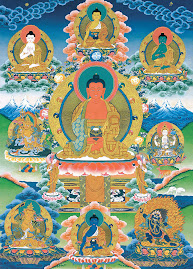
Shri Hevajra (Tibetan: pal gye pa'i dor je. English: Glorious Joyful Vajra): principle meditational deity of the Sakya School and central focus of the Lamdre cycle of teachings, together with eight goddesses, deities and lineage teachers above and protectors below.

SHRI HEVAJRA (Tibetan: pal gye pa'i dor je): principle tutelary deity of the Sakya School and central focus of the Lamdre cycle of teachings. Wrathful in appearance, dark blue in colour with multiple heads and hands he stands in a dancing posture amidst orange flames of wisdom fire.

At each side of the central blue face are three further faces with a small fierce face placed above making a total of eight. Each face has three eyes, yellow hair flowing upward, a crown of five skulls and earrings. With sixteen hands each holds a skullcup and a unique object inside. The first pair folded at the heart embrace the consort Vajra Nairatmya, light blue in colour with one face and two hands, holding aloft a curved knife with the right hand, standing embracing the consort with the right leg. Both are adorned with various wrathful ornaments, bones, skull garlands and the like. Atop a series of stacked figures, sun disc and multi-coloured lotus seat they stand completely engulfed in the orange flames of pristine awareness. In a half circle standing in front are the eight goddesses of the Hevajra mandala each with one face and two hands of various colours, holding unique symbolic objects and standing in dancing postures.

At the top center is the primordial buddha Vajradhara, blue, with one face and two hands holding to the heart the stems of two lotus blossoms supporting a vajra and bell. At the left is a mahasiddha, dark in colour, wearing a red meditation belt. At the right is a peaceful figure attired in the garb of a bodhisattva. At the far left is Sachen Kunga Nyingpo (1092-1158), dressed as a layman, holding a white lotus blossom in the right hand. At the far right a lama wears monastic robes and a red pandita hat. Below that are three lamas in a row all wearing monastic robes and performing various mudras. The central figure is seated on a large multi-petalled pink lotus.

At the middle left is Vajrayogini, red, with one face and two hands, in a standing posture. At the right is Bhutadamara Vajrapani, dark blue, wrathful, with one face and two hands.

At the bottom center is the wrathful protector Panjarnata Mahakala, black, with one face and two hands. At the right is the wrathful consort Shri Devi, black, with one face and four hands riding a brown mule. At the left is Brahmarupa Mahakala, in the appearance of an Indian mahasiddha. These are the three main Dharma protectors of the Sakya School.

Hevajra Lineage: Vajradhara, Nairatmya, Virupa, Kanhapa, Damarupa, Avadhutipa, Gayadhara, Drogmi Lotsawa, Seton Kunrig, Shangton Chobar, Sachen Kunga Nyingpo, etc.

Yamantaka


VAJRABHAIRAVA YAMANTAKA:

A TANTRIC INITIATORY VISION
"The secret of the body is Vairochana and the Dhyani Buddhas;
The secret of speech is Locana and the Buddha consorts;
The secret of the mind is Yamantaka and the Wrathful Ones."
(Ratnakarashanti)


The form of Yamantaka represented here is known as Ekavira, the "Solitary Hero". The Sanskrit term Vajrabhairava means the "Adamantine Terrifier" and Yamantaka means "Remover of the Obstacle Yama (the Judge of the Dead)."

This impressive sculpture, done in wood and finished with multi-colored lacquer, has a height of 52.25 inches (132 cms). Collected by the American artist George Grey Barnard, in Tibet, before World War II, for many years it was on loan to the Museum of Natural History in New York and is now in the permanent collection of the Virginia Museum, Richmond. It has been radiocarbon dated at between 1150 to 1290 C.E., which is the early Yuan period, falling comfortably within the reign-period of Kublai becoming Supreme Khan and Emperor of Mongolia and China (in 1260 C.E.).

Immediately following Kublai Khan's becoming Supreme Emperor, Karma Pakshi (1204-1283) the second Karmapa hierarch traveled to China, spending six years there and became the Supreme Teacher of this Emperor. It is known that Kublai was initiated into the mysteries of Yamantaka. The date-range of this magnificent Tantric sculpture also falls comfortably in the period of the Nepalese Master sculptor/artist Aniko's long stay in China at the request of Kublai. The unusual iconography, style, choice of materials and overall effect of this impressive image suggests that it is indeed a masterwork done by Aniko or his immediate entourage.

THIS TANTRIC VISION
This 34-armed, 16-legged awesome form of Ekavira Vajrabhairava Yamantaka has a central bulls head with long black horns and the body colored deep dark blue-black. The main and largest head wears a tiara of human skulls surmounted by an elaborate five-fold gilded crown embellished with the Buddhist "Wheel of Law" motif. Above, the hair stands on end and is treated much like the style seen in Mahakala images - "with scorpion-sting shaped tips." The mouth is open wide to reveal teeth, a lolling tongue and large red lips. The eyes are large, protruding and blood-shot, a "third eye" located at the center of the forehead. The eyebrows are angrily knitted and elaborately raised and gilded. In total there are eight main heads - a yellow one to the proper right, a red one to the left, followed by others of pink, white/grey and blue - plus a ninth small crowned red head of the Bodhisattva Manjusri at the apex. These nine heads are in Tantric texts, linked to the nine classic "sentiments."

The central main hands of the deity hold a chopping-knife (karttrka) and human skull-bowl (kapala), colored gold and ornamented by pearl chains, flammiforms and scepters (vajra). The lower main hands hold a magical knife (purba) and the severed multi-faced head of Brahma the Creator. The upper main hands hold a red right hand holding an arrow and an elaborately decorated golden shield with a Chinese-style makara or dragon face at the center. The other hands hold a ritual scepter (vajra), lance, axe, double-drum (damaru), Wheel of Law (dharmachakra), dagger, swirling flames, ritual bell (ghanta), skeleton-staff (khatvanga), banner, a red human right foot, a transfixed corpse, various magical knives and stakes, a noose, a skin, and other Tantric weapons.

The deity wears snake-bracelets, an elaborate chain and pearl motif looped necklace, armbands, an intricate draped girdle, anklets and other Dharmapala ornaments done in a style normally seen in the Yongle-period bronzes of Yamantaka and Mahakala. Everywhere the decoration, done in raised gilded lacquer and/or wood, is lavishly finished. A garland of human heads of different types and colors is threaded on an iron band draped around the neck of the deity and descending almost to the ankles. Seen from the back and sides, the massivity of this subject is all the more apparent. The layers of legs and arms convey a feeling of hallucinatory exuberance; the pair of legs at the extreme back are off the podium, as if in dance. The main legs are in the alidhasana posture, the row of right legs bent at the knee and the left legs straight. This pose, taken from classical Indian dance, is common in sculpture and dance from Eastern India, especially Orissa.

The deity stands on the back of a row of birds (under the proper left foot), animals (a horse, a bull) and a man (under the right foot), and four small figures plus a large bird in obeisance can be seen on the podium. Together, they all represent the "four ancient classes of beings" (birds, animals, humans and gods). The three seated figures are the Hindu "trinity" of gods - a multi-headed Brahma holding an elixir-vase, a single-headed Vishnu and a multi-headed Shiva. The large bird is the Garuda, spiritual vehicle of Vishnu. The human figure on one knee in front of the left foot of the deity almost certainly is the donor king or prince who originally commissioned the icon. He wears a crown and the armor of a Mongol warrior and may be a portrait of Kublai himself.

The lotus podium is of a most unusual type. Generally one sees double lotus podiums, one above the other, and if single, the lotus petals point downwards. The row of single upward-turned lotus petals on the base of this icon go all around. The petals are modeled in the typical early Yuan fashion, with elaborate swirling formalized patterns repeated and the tips of the petals protruding outwards. Each petal has its design raised, embellished and colored. A row of "pearls" of even size encircles the upper part of the podium. The podium top is lacquered Imperial red.

The hands and feet have protruding nails or claws, and an elaborately draped scarf, done in red on the inside and decorated with Imperial gold flowers and foliate motifs, and of dark blue and gold on the outside reaches from behind the head of the deity to just above the feet.


THE MYTHIC BACKGROUND
In ancient Iranian mythology Yima, the first man, is cast out of Paradise, perhaps because of an incestuous liaison with his sister, Yimak. In the Vedas of India there are suggestions that Yama and Yami were once an Original Being, a primordial hermaphrodite couple. The Rig Veda tells how Yama's twin sister Yami attempts to seduce him but is rejected.

In the Upanishads Yama is presented as the "Virile Lord", a little wild perhaps, a "husband of women and lover of maidens", while also serving as "Judge of the Dead". King Yam or "Yam Raj", the "God of Death" of popular Hinduism, is also the Great Instructor into the mysteries of life and the hereafter. Yama is described as being like a dark male buffalo, or in human shape as a dark man riding a male buffalo and holding a club or staff. His domain was supposed to be "in the South". Interestingly, the aboriginal Bhil tribal peoples of India, who are dark complexioned, treat Yam Raj as a great god and call him by the name "Zom" in their language. They say that Zom and his sister exchange special presents on particular days and believe that at death the soul follows Zom's orders.

Yama becomes connected to the Bhairava or wrathful form of Shiva in the Hindu Tantric tradition. This form of dread and terror was assumed after Shiva decapitated Brahma the Creator. Brahma's head became Shiva's begging bowl, which finally fell from his hand at Varanasi, where he overcomes Time (kala) to become Mahakala, the Great Black One, popularly known to Tantric Yogis as "Kal Bhairav".

Yama's sister Yami is associated with the sacred river Yamuna, connected to the main Subtle Channel (nadi) on the left, the "Path of Death". She is further associated with Chamunda (the emaciated yogini and Mother Goddess of the cremation-ground) and Durga (the mystic form of Shiva's consort Uma/Parvati/Kali). The eight Bhairava-forms of Shiva (named Krodha, Kapali, Canda, Ruru, Samhari, Asitanga, Bhisana and Unmatta in one tradition) have the eight Mother Goddesses (matrikas) as magical consorts or "sisters", and are further connected to eight Great Cremation-grounds which become the main places for Tantric initiation and are usually depicted around the outer edge of Tantric mandala paintings from Nepal and Tibet, whenever a wrathful form is at the center.

The Hindu rites of Yama are generally supposed to be necromantic and take place at midnight during the dark of the month, in the cremation-grounds. The dark wrathful Yogi of Shaivite style - with hair wild and matted, eyes red and bulging from intoxicants, body covered with funeral ashes, draped in animal skins and snakes, holding a trident and eating from a human skull-bowl - become an icon of initiation, a Mahakala or Bhairava, who can take the seeker through the dark mysteries of death and into the clear light of Self-realization.

The confrontational and spontaneous initiatory approach of the Indian Siddha Yogis has been well documented in history and at the present time. Some Tibetans who had the fortitude and courage to reach India and seek out Tantric Masters in the sacred cremation-grounds must have experienced Yama as an awesome initiatory vision which remained with them for always. Knowledge of the mysteries of death are the goal of all higher mystic practices. Those of Buddhist inclination saw Yama as Yamantaka, "Remover of the Obstacle of Death", as a "Protector of the Buddhist Dharma" and the "Ultimate Judge of all Karmic acts".

Madanjeet Singh, author of a fine book on Himalayan Art and culture, retells the popular Tibetan story as to how Yamantaka got his bull's head:

"The origin of the bull-head is ascribed to the tradition which speaks of a holy man who lived in a cave, practicing meditation. As he was about to achieve his objective and enter nirvana, two thieves with a stolen bull entered the cave and slaughtered it. When they saw the ascetic, a witness to their crime, they beheaded him too. But to their astonishment, the victim lifted the head of the bull and replacing his own severed head with it, became the ferocious form of Yama. He then not only devoured the two thieves, but his insatiable thirst for human blood threatened the whole population. The followers of the Vajrayana, therefore, appealed to Manjusri who, then assuming the fierce bull-headed form of Yamantaka, defeated Yama in a fearful struggle."


"Yamantaka is an important deity in both the 'old' and 'new' Tantra traditions. The clear and penetrating wisdom of Yamantaka is the slayer of death."

================================================

Buffalo-Head

There was once a yogi who lived in isolation in a cave in the mountains where he practiced meditation with determination. One day, while sitting in profound samadhi and just about to achieve the Awakened State that is called Enlightenment, two cattle thieves dragging their prize of a dead water buffalo just happened to find the cave. Thinking they were alone, they began to butcher the meat by first removing the head from the rest of the carcase.

When they noticed the ascetic, who would certainly be able to identify them to authorities, they smoothly and swiftly beheaded him, too. The siddha, in a fury that his objective -- so near in that lifetime -- had been thwarted, reached out and grabbed the closer of the heads lying there, and with a twist of his wrist, installed the missing part. It happened to be that of the bull.

Thus, his prior spiritual attainment combined with his anger, frustration and animal fury to cause him to take on the form of the most ferocious of the devas, Lord Yama, God of Death (Chinese: Yen-Lo-Wang.) Having assumed this form he not only slaughtered the two cattle rustlers, but went on a rampage that threatened the population for miles around.

In desperation, followers of the Buddha-dharma appealed to the Great Bodhisattva, Manjushri, for help. Jampel Yang (as Manjusri is known in Tibetan,) having both wisdom and compassion, as well as superior knowledge, used like to conquer like. He assumed a fierce bull-headed form himself and put an end to the furious and mindless predation of that particular version of Yama, the Lord of Death.

---o ---o ---o ---o ---o ---o ---o ---o

As the manifestation of Manjushri, he is shown as black or midnight blue (Karma Kagyu form).

Yamantaka (Defeater of Death) is one of the Drag-ched -- eight Dharmapalas, Protectors of the Teaching of the Buddhas.


Though they are terrifying in appearance they are all bodhisattvas -- embodiments of compassion that can manifest out of Emptiness to act in an extremely wrathful way for the sake of sentient beings.

Also called Yamari (Yama's enemy,) Yamantaka is only one aspect of Vajrabhairava (Absolutely Terrifying,) usually depicted as riding or standing on a bull that is trampling Yama.

Yamantaka: The Conqueror of Death

Yamantaka, the ferocious emanation of Manjushri (Bodhisattva of wisdom), is the most complicated and terrible of all the wrathful Buddhist divinities. Under this from he conquered the demon king of death, Yama, who was depopulating Tibet in his insatiable thirst for victims. According to this myth, in his paroxysm of insight, Manjushri traveled all the way to the underworld to seek out Yama,

Yama appears in Indian mythology with the head of a water buffalo. To tame Yama, Manjushri adopted the same form, adding to it eight other faces and a multiple array of arms, each holding fearful and deadly weapons. He further sprouted a corresponding number of legs, and surrounded himself with a vast host of terrifying beings. To confront death, he thus manifested the form of death itself, magnified to infinity. Death (Yama) saw himself endlessly mirrored back to himself, infinitely outnumbered by himself. Death was literally scared to death. Thus the yogi who meditates through the imagery of Yamantaka intends and hopes to develop a sense of identity strong enough to face down death, and the fear that attends upon it. Each head, each limb, each attribute, symbol and ornament of Yamantaka expresses the total mobilization of the faculties of enlightenment needed for this ultimate confrontation.

Both Yama and Yamantaka are represented with bull’s heads, but Yama always has an ornament, shaped like a wheel on his breast, which is his distinctive mark.

Uccusma Vajrapala Great Sovereign Divine King


AN INTRODUCTION TO THE

‘UCCHUSMA VAJRAPALA GREAT SOVEREIGN DIVINE KING BUDDHA’


The origin of the Ucchusma Vajrapala has two versions; one of which is from the famous Surangama Sutra, the other the Ucchusma Vajrapala Sutra.
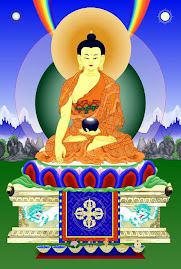
The Surangama Sutra states that the Ucchusma Vajrapala is actually an accomplished spiritual-practitioner during Shakyamuni Buddha’s time. At the Dharma assembly whereby the Surangama Sutra was first delivered, the Ucchusma Vajrapala recounted His own experience at spiritual cultivation to Shakyamuni Buddha, "I remember that many aeons ago, when I was a lecherous mundane being, there lived a Buddha by the name of the ‘Emptiness King’. The Buddha preached that persons with strong sexual desire are like pathetic souls engulfed in great flames. Meanwhile, He taught me to be mindful of the cold and heated inner energies circulating throughout my body and limbs. Practising thus, I managed to gather and consolidate the Divine Brilliance within me, eventually enabling the transformation of my lust into the Fire of Wisdom. From then onwards, all Buddhas began to call me the ‘Fire Head’.

"Utilising the power generated by the Fire Brilliance Samadhi, I finally attained Arahathood. I made the great vow that I would become a Guardian Deity to protect the teachings of the Buddhas, and to personally subdue all demonic obstacles."

Due to His distinct method of attaining spiritual enlightenment, the Ucchusma Deity is also known as the ‘Fire Head Vajrapala’.

The Ucchusma Vajrapala Sutra, on the other hand, asserts that the Ucchusma Deity is actually the Vajra manifestation of Shakyamuni Buddha. Legend has it that when Shakyamuni Buddha was about to enter into Nirvana, all heavenly beings, with the exception of the ‘Spiral Hair-knot Brahma King’, came to pay their respect to Him. The Brahman King was in fact enjoying himself with the heavenly maidens in his own celestial palace. The heavenly gods, being unhappy with the arrogance of the Brahma King, went to his abode and try to persuade him to attend the Dharma assembly. Upon reaching his palace however, the gods found themselves trapped in the defiled energy cast by the supernatural powers of the king. Even some of the Vajra Deities who were later sent to apprehend the Brahman King were imprisoned by the foul forces as well.

When Shakyamuni Buddha came to learn of this, He employed His Origin Wisdom, and the Light of Perpetual Joy and Pliancy was emitted from His heart. The Ucchusma Vajrapala soon appeared from amidst the revolving radiance of the Buddha’s heart, and ascended to the celestial palace of the Brahma King. Despite the defiled energy hurled at Him by the Brahman King, the Ucchusma Deity was unharmed as He immediately turned these forces of contamination into ordinary soil. In no time, the Brahma King was subdued and brought to the feet of Shakyamuni Buddha.

For this reason, the Ucchusma Deity is also known as the ‘Filth-eliminating Vajrapala’.

The Ucchusma Vajrapala is venerated in both Eastern Tantrism and the Tibetan Tantrayana School. Khro bo sMe brtzegs, mNol ba med pa, sMe ba brtsegs pa and Bhurkumkuta are some of His Tibetan names. Nevertheless, the Deity is more popular amongst followers of the Eastern tradition. This is especially so in the case of the Chinese Tian Tai Tantric sect, whereby the Ucchusma Vajrapala is revered as a Deity belonging to the Karma (Enlightened Activities) group of spiritual practices. In the Shingon tradition however, this important position of the Ucchusma Vajrapala is replaced by the Vajrayaksha Deity.

In addition, it must be noted that the cultivation-method of the Ucchusma Vajrapala is not commonly known. Although the practice is recorded in the earlier collections of Dharani Sutras, it is not found in the later and major Tantric scriptures such as the Mahavairocana Sutra and Vajra Peak Sutra.


UCCHUSMA VAJRAPALA AND THE TRUE BUDDHA SCHOOL

The Ucchusma Vajrapala is one of the two uncommon Vajra Guardians of our True Buddha School (the other Dharma Guardian being the Acala Vajrapala).

According to Grand Master Lu’s seventy-sixth book, "Night at the Phantom Lake", great Karmic affinity has been forged between the Deity and True Buddha School even before the Maha Padmakumara has descended unto this world. Below is an extract from the book:

"(After the Maha Padmakumara, Ksitigarbha Bodhisattva and the other Buddhas and Bodhisattvas had failed to deliver the suffering beings out from the boundless and turbulent ‘Lake of Blood’ situated in hell, due to the tremendous amount of filth that had existed therein…..) At this moment, Shakyamuni Buddha said, ‘The Maha Padmakumara will soon descend upon and be born in the Samsaric world, to fulfill a Dharma aspiration of crucial importance. Moreover, I am the One who shall prophesy and affirm His Buddha hood Enlightenment in the future. Therefore, it is imperative that I should assist Him to salvage the sentient beings that are suffering in the Lake of Blood.’ Speaking thus, a revolving blue brilliance was emitted from the heart of the Holy One.

"From within the blue brilliance, the majestic Ucchusma Vajrapala Great Sovereign Divine King Buddha manifested. The Vajrapala appeared in the form of a wrathful deity, with eight arms, red eyes and a deep-blue colored body with great fire brilliance radiating around Him. His hands were either forming mudra or grasping Dharma implements, which includes a sword, silk rope, a stuff and a three-forked lance. More impressively, each of the Deity’s arms was ornamented and coiled around by a dragon.

"The Ucchusma Vajrapala is also known as the Fire Head Vajrapala, the Indestructible Vajrapala and the Impure Vajrapala. His origin vow is to devour and eradicate all filth and impurities.

"The Ucchusma Vajrapala stood amidst the emptiness with an unrivaled lofty bearing. Upon smelling the foul and pungent scent of blood, the eight dragons winded around His arms were eager for action.

"The Ucchusma Vajrapala then straightened His arms and all the dragons immediately darted from Him, revealing their true spiritual forms. The eight dragons were so gigantic that they were able to swallow the water contained in three lakes with a single gulp.

"In actuality, the eight dragons were:
1. The Sagara Dragon King,
2. The Nanda Dragon King,
3. The Upananda Dragon King,
4. The Vasuki Dragon King,
5. The Taksaka Dragon King,
6. The Anavatapta Dragon King,
7. The Manasvati Dragon King,
8. The Utpalaka Dragon King .


"The eight dragon kings circled in the mid-air and were intensely excited. They opened their mouths and drank up the filthy blood in the lake, swallowing even the blood monsters dwelling within it. In no time, except for the suffering sentient beings at its basin, the lake was emptied and dried..

"The Ucchusma Vajrapala Great Sovereign Divine King Buddha again stretched out His eight arms to recover the eight dragon kings. All eight dragons returned and were coiled back the arms of the Vajrapala. Such magnificent spectacle had won for the Deity praises from the Buddhas and Bodhisattvas who were present:

This is indeed the ‘Great Sovereign Divine King Buddha’!

A great Vajrapala omnipresent throughout the Dharma realms,

Consistent in His compassionate vow to salvage all Samsaric souls;

Neither loathes nor forsakes places that are filthy and foul,

He manifests instantly upon the prayers of sentient beings.

"The Ucchusma Vajrapala was transformed into the blue brilliance, which returned into the heart of Shakyamuni Buddha."

SOME BENEFITS OF THE UCCHUSMA PRACTICE

1.) Elimination of Filth
This perhaps, is the most unique feature of the Ucchusma Vajra Yoga. It implies the elimination of all defiled things, as practising the cultivation-method can not only enable the subduing of all demons, it can also convert sexual desire into the Fire of Wisdom. Besides, evil spirits and poisonous snakes will not dare to come near one who is cultivating the Ucchusma practice.

‘Ucchusma’ in Sanskrit can be defined as ‘to scavenge for the leftover food on the mouth and hands’. This in turn reveals the Deity’s preference for foul things and likewise, His ability at purifying contaminated matters. For this reason, the Ucchusma Vajrapala is often worshipped in the lavatories of Japanese temples.

2.) Enhancement of the Masculine Energy
With the elimination of filth (which is considered a feature of the Feminine Energy), the Dharma-cultivator’s Masculine Energy is therefore enhanced. As a result, children of the Ucchusma practitioner will be sons rather than daughters, for feminine souls are unable to utilize the body of the cultivator to gain rebirth. In addition, the cultivator shall have no fear for spiritual disturbances and other forms of superstitious taboos.

3.) Spiritual Enlightenment & Supernatural Powers
It must be mentioned that those who have achieved spiritual response in the Ucchusma method, will soon attain Buddhahood enlightenment. Subsequently, the accomplished Ucchusma cultivator can also perform supernatural acts. He is able to avert natural calamities and overpower poisonous dragons, simply by reciting the Ucchusma mantra and pointing the Ucchusma mudra at his desired objective. He can even delay the death of a dying person, dispel black magic, erect spiritual boundaries, command powerful spirits and wild beasts, enable a dried lake to be refilled with water, a withered tree to produce new sprouts and a scorched hill to regain its greenery.
4.) Worldly Benefits
Practicing His method will result in the generation of tremendous merits. It can also, among many other things, allow for the eradication of illnesses and disasters, the attainment of great magnetizing powers, the prevention of dire accidental occurrences, acquisition of great fortune and the subduing of one’s grievance foes.


_________________
Om Mani Padme Hum